
By Arnold Tutu
Zambia has renewed its focus on value addition in the mining sector as a cornerstone of its economic transformation agenda.
 And Zambia’s Ambassador to Japan, TOBIAS MULIMBIKA is calling for stronger international partnerships to accelerate industrialisation.
During a courtesy call by GHAZI FAISAL BINZAGR, Ambassador of the Kingdom of Saudi Arabia to Japan, at the Zambian Mission in Tokyo, Dr. MULIMBIKA said the Zambian Government is prioritising mineral processing and downstream manufacturing in a deliberate shift away from exporting raw materials.
He said the approach is intended to drive industrial expansion, generate employment and deepen Zambia’s participation in regional and global value chains.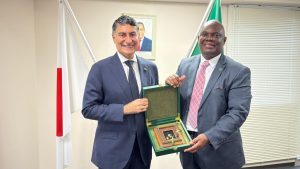
“Value addition is central to Zambia’s economic transformation programme. By focusing on mineral processing and manufacturing, we are positioning ourselves to secure greater returns from our natural resources,” Dr MULIMBIKA said.
He also cited Zambia’s strategic position as a land-linked country bordered by eight nations, offering investors access to a regional market of more than 600 million people through its membership in regional economic blocs.
Key infrastructure corridors — including the Nacala, Dar es Salaam and Beira routes — were described as vital channels for trade and investment.
Dr MULIMBIKA said the corridors play a significant role in strengthening supply chains and opening up opportunities across mining, agriculture, energy and other productive sectors.
He said Zambia continues to utilise Public-Private Partnerships –PPPs- to deliver major infrastructure projects within a clear legal and regulatory framework.

Dr MULIMBIKA indicated that Zambia stands ready to engage Saudi investors in bankable projects aligned with national development priorities.
In his remarks, Ambassador BINZAGR said Saudi Arabia is keen to expand cooperation with Zambia in infrastructure, mining, agriculture, energy transition and health.
He spoke of the need to optimise value chains for mutual economic gain, improve supply chain resilience and build transparent, sustainable partnerships.
Ambassador BINZAGR also pointed to prospects in energy transition initiatives, including hydrogen development, and called for long-term coordination in infrastructure planning.
Both envoys spoke of the need to invest in human capital development and skills enhancement to underpin industrial growth and sustainable economic diversification, particularly given Africa’s youthful population.
The meeting closed with a shared undertaking to pursue strategic partnerships aimed at advancing sustainable development and long-term economic resilience.
The statement was issued by FAITH NABEENE CHILUBE, First Secretary for Press and Public Relations at the Embassy of the Republic of Zambia in Tokyo, Japan.